
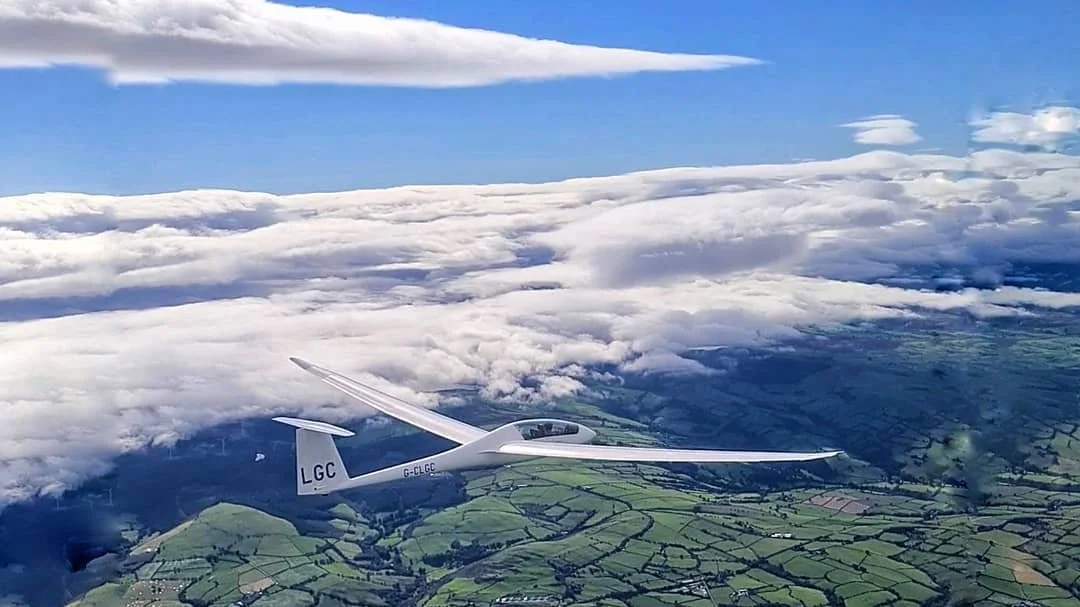
Badge Paperwork & Guidance
So you have achieved the BGA Bronze Badge with the Cross Country Endorsement, you are considered a Qualified Glider Pilot and are in the process of applying for your SPL. You are now putting some thought into working out what is going to be next in store for you and your gliding adventure. This page is there to give some assistance as to what you need to do.
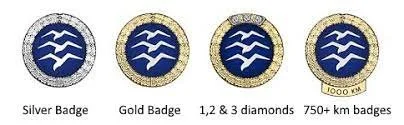
The Badges
For the FAI Silver Badge:
A distance flight of at least 50km
A duration flight of at least 5 hours
A gain of height of at least 1000m
For the FAI Gold Badge:
A distance flight of at least 300km
A duration flight of at least 5 hours
A gain of height of at least 3000m
For the FAI Diamond Badges:
A distance flight of at least 500km
A goal flight of at least 300km
(either O/R or Triangle - these MUST start/finish at the same point)A gain of height of at least 5000m
FAI Distance Diplomas:
Awarded for a distance flight of at least 750km with subsequent awards at every additional 250km (1000km, 1250km, etc).
IMPORTANT:
Closed Circuit Tasks MUST Start/Finish at the same point
Notes
Any airspace infringements will mean the claim is invalid.
As with anything in gliding, if you are not sure, ask.
If using a GPS only logger for Silver or Gold badges then you must allow an additional 100m on all heights given to allow for GPS error. They are not valid for any Diamond Badge or Distance Diploma. You therefore can only have a maximum of 900m difference in start/finish altitudes.
If the conditions on the day suit, you can achieve multiple parts of badges or mutiple badges in one flight.
It is worth reading the “FAI Sporting Code - Section 3 (Gliding)” for the correct wording and definitions for the badges, this can be access on google but make sure the version you find is the most upto date one as small changes happen every now and then to it.
As of June 2025 the latest version is dated October 2024.
You should familiarize yourself with whatever device you intend to use as the logger well before the day of a badge attempt, so that you don't miss out on a badge claim because you failed to record the flight appropriately.
Finally, but most importantly, get in touch with one of the club Offical Observer’s (O/O’s), as they should be able to help you with the preparation needed before and after your attempt. There is a list of them in the clubhouse.

The Silver Badge:
Note that this is the lowest internationally recognised level of gliding achievement.
The 50km flight:
Until now, the majority of your solo flying must have been fairly local to your launch point. One of the primary aims of this flight is to break the bond you have subconciously made to this point by not getting too far away and forces you to get out of gliding range of your home airfield.
You must fly at least 50km away from both your launch point and release point and the height at which you start must be no more than 1% of the distance you intend to cover.
1% of 50km is 500m which converts to 1640ft. To keep it as simple as possible at LGC, ask the tug pilot to aim to have you overhead the club at ~1500-600ft so you can release at that point.
The common airfields you would likely be sent towards from LGC are: Enstone, Husbands Bosworth or Upwood.
The 5 hour flight:
Pretty simple really, you must fly for at least 5 hours, allowing a bit of time (10-15mins) for the launch. This flight can be signed off without need of a logger trace provided you were under continual observation (ie you were Hill Soaring on the local ridge… Yes, it can and has been done!).
This flight will also automatically count towards the Gold Duration flight.
Make sure you have taken enough water/snacks for this flight as well as the ability to relieve yourself in-flight.
However, if you feel like you can’t complete it on the day for whatever reason, don’t push your luck, land when safe to do so, there will be plenty of other chances!
The 1000m height gain:
Relativly simple, but the order in which it is worked out is a low point followed by a high point. Note 1000m is 3281ft, 3300 for simplicity.
This can easily be done from LGC on the right day but you would likely need to get to the airspace just outside of the local area.

The Gold Badge:
The 300km flight:
A distance flight of at least 300km using upto 3 Turn Points during the flight. However, if set properly you can also claim this for your Diamond Goal.
The Start/Finish point(s) can be a line of no more than 500m radius from the point. It is best to use the BGA list for all Points.
Each turn point can have a 500m barrel around it which will count as having “turned” the point but 1km of distance will be subtraced from the flight distance.
The difference in Start/Finish heights must be no more than 1000m.
You can Start/Finish at different places, just bear in mind the elevation of the finish point with regards to your start height.
The 5 hour flight:
This achievement will have been automatically signed off when you did it for your Silver Duration, no need to do it again!
The 3000m height gain:
Just like the Silver Height, but you need to get higher. Note, as 1000m is 3281ft, rounded to 3300ft for simplicity, this makes 3000m as a 9900ft gain.
Talgarth or Denbigh would be the logical places to go to get these when the conditions are suitable.
The Diamond Badges:
Note that these are each considered an achievement in their own right
The 500km flight:
A distance flight of at least 500km using upto 3 Turn Points during the flight.
The Start/Finish point(s) can be a line of no more than 500m radius from the point. It is best to use the BGA list for all Points.
Each turn point can have a 500m barrel around it which will count as having “turned” the point but 1km of distance will be subtraced from the flight distance.
The difference in Start/Finish heights must be no more than 1000m.
You can Start/Finish at different places, just bear in mind the elevation of the finish point with regards to your start height.
The 300km Goal flight:
A closed circuit (Start/Finish at the same point) flight with upto 2 Turn Points of at least 300km. If set properly, this will also count as your Gold Distance.
The Start/Finish point can be a line of no more than 500m radius from the point, from LGC it is best to use LEZ or LBZ. It is best to use the BGA list for all Points.
Each turn point can have a 500m barrel around it which will count as having “turned” the point but 1km of distance will be subtraced from the flight distance.
The difference in Start/Finish heights must be no more than 1000m, this is another reason for using LEZ or LBZ as the Start/Finish as to make it back to LGC you should be within 1000m of the airspace above you so it is one less thing to worry about.
The 5000m height gain:
Just like the Gold Height, but you need to get higher still. Note as 1000m is 3281ft, rounded to 3300ft for simplicity, this makes 5000m as a 16500ft gain.
Chances are you will need to travel further afield to get this, Scotland is the most common destination to get this badge if staying in the UK, although in the right conditions it can be achieved at Denbigh which is considerably closer.
The Distance Diplomas
Awarded at 250km increments from 750km.
The rules for this follow the same rules as both the Gold and Diamond Distance flights.
GPS only loggers are NOT valid for ANY Distance Diploma claims
If you have gotten this far then you probably know that 750km can be done on the right day and we usually have at least one day each year at LGC when this can happen.
On the day of days, 1000k can be done in the UK in thermals, if you do this you will be in a VERY exclusive club. More people have walked on the moon…!
It is not uncommon to see it done in wave in Scotland but chances are you will need to go overseas to get these badges. South Africa/Namibia in the winter or mainland Europe in the Summer would be the places to go.

Records
British gliding records fall into two principle categories: UK and National. UK records are for flights flown in the UK whereas National records are for flights by British pilots and which can be flown anywhere in the world. Within the UK record category there are records for the four diffferent sailplane classes (Open, 20m, 15m and Standard) and, within the National record category, records for the Open and 15m classes. There are also separate feminine records for all of these record categories.
For a link to the BGA Records page, click HERE.
Distance Records
A new record claim must exceed the current value by at least 1 km. If the loss of height (LoH) between the start point and the finish point is greater than 1000 metres, the achieved distance shall be reduced by 100 (LoH – 1000m) metres to give the official distance.
Below is a list of different types of Distance Record
a. Goal Distance
Declared start and finish point with no turn points (TPs).
b. Free Distance
Any start point and finish point with no TPs.
c. Out-and-Return
Closed course with declared start/finish and only 1 TP declared.
d. Free Out-and-Return Distance.
Closed course with 1 TP selected from a position fix.
e. 3 TP Distance
Release or Declared start point to any finish, via 1 to 3 declared TPs.
f. Free 3 TP Distance
Start, Finish, and 1 to 3 TPs selected from position fixes.
g. Triangle Distance
Closed Course, declared start/finish with 2 or 3 declared TPs.
h. Free Triangle Distance
Closed Course with 2 or 3 TPs selected from position fixes.
Speed Records
A new record claim must exceed the current value by at least 1 km/h. The speed is defined by the official distance divided by the time required to achieve all the way points of the closed course. A loss of height between the start point and finish point greater than 1000 metres will invalidate the claim.
a. Out & Return
Speed Course as in 3.1.5c with a distance of 500 km or multiples of 500 km.
b. Triangle speed
Course as in 3.1.5g with distances of 100, 300, 500, 750, 1250 km, or greater multiples of 500 km. A record may be claimed for the declared course and any shorter triangle in compliance with the applicable triangle geometry requirements in 3.1.8.
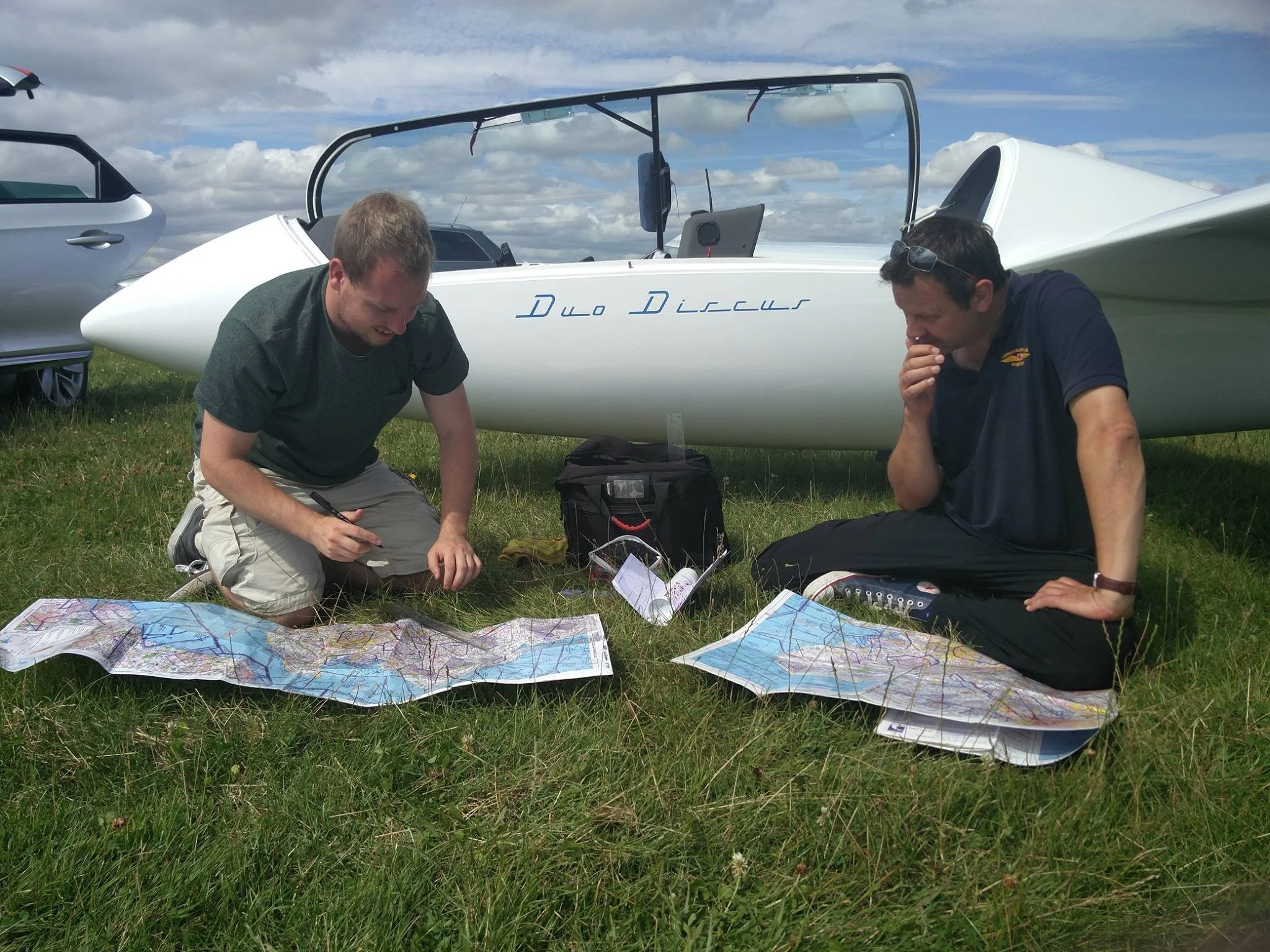
Becoming an Official Observer
If you are interested in becoming an Official Observer you need:
Full Silver C
ORContinuously Connected with the Active side of gliding for 3 Years
The ability to read and understand the FAI Sporting Code for Gliding
The recommendation by the club chairman
Sending the appropriate paperwork to the BGA
Whilst it is not a requirement, the ability to operate and understand the SeeYou planning/analysis software will also be beneficial as this is the software you will use to read the .IGC files that the loggers create.
There is no need to own the software as the club PC’s have them installed but chances are you may already own it so you can review your own flights.
There is no application fee and no renewal requirements other than keeping upto date with the Sporting Code.